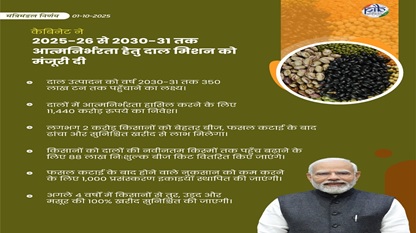
Approval of “Pulses Self-Reliant Mission”
 
  • Mobile Menu
HOME BUY MAGAZINEnew course icon
LOG IN SIGN UP

Sign-Up IcanDon't Have an Account?


SIGN UP


Login Icon

Have an Account?


LOG IN
 

or
By clicking on Register, you are agreeing to our Terms & Conditions.


or


Approval of “Pulses Self-Reliant Mission”

Sat 04 Oct, 2025

Context:

  • The Union Cabinet has approved the “Pulses Self-Reliant Mission” with the objective of making India self-reliant in pulses production.

Mission Overview :

Key Point Description
Duration 6 years (FY 2025-26 to 2030-31)
Total Financial Outlay ₹11,440 crore
Main Objective To reduce dependence on imports by promoting domestic production and make the country self-reliant in pulses.
Need India is the largest producer and consumer of pulses globally, but domestic production does not meet demand, requiring imports of about 15-20% of pulses.


Key Targets and Objectives

The mission will strive to achieve the following targets by 2030-31:

Parameter Current Level (Approx.) Target for 2030-31
Total Production 242 lakh tonnes (2023-24) 350 lakh tonnes
Cultivated Area 242 lakh hectares 310 lakh hectares
Productivity (Yield) 881 kg/hectare 1,130 kg/hectare
Target Farmers Reach approx. 2 crore farmers  
Focus Crops Special focus on Tur (Arhar), Urad, and Masoor  

Implementation Strategy

A. Seed System and Research:

  • High-quality seeds: 88 lakh free seed kits will be distributed to farmers to enable adoption of high-yielding, pest-resistant, and climate-resilient new varieties.
  • Seed Distribution: 126 lakh quintals of certified seeds will be distributed by 2030-31.
  • Tracking and Quality: Seed quality and distribution will be monitored via the SATHI portal.
  • Cluster-based Approach: A cluster approach will be adopted in 416 target districts to ensure optimal use of resources.

B. Area Expansion and Diversification:

  • Utilization of Fallow Land: Rice fallow land and other diversifiable areas will be brought under pulses cultivation.
  • Intercropping: Pulses will be grown along with other crops (e.g., Tur with maize/sugarcane) to increase the cultivated area.

C. Price Support for Farmers:

  • Assured Procurement: Procurement of Tur, Urad, and Masoor under the mission will be 100% ensured at Minimum Support Price (MSP). This will encourage farmers to cultivate pulses by providing fair prices.

D. Post-Harvest and Value Addition:

  • Infrastructure Development: To reduce post-harvest losses and promote value addition, 1,000 new processing and packaging units will be established, with a subsidy of up to ₹25 lakh per unit.

Challenges and Potential Risks

  • Climate Change: Irregular monsoon may affect production. New varieties will address this, but implementation delays may occur.
  • Market Linkages: Despite MSP procurement, private traders’ interventions may affect farmers. Strengthening NAFED/NCCF capacity is needed.
  • Awareness and Training: Reaching small farmers; use of digital portals is limited in rural areas.
  • Budget Implementation: Ensuring proper utilization of ₹11,440 crore. In the previous NFSM, 10-15% of funds remained unutilized.
  • Import Pressure: Volatility in global prices may limit short-term relief.

Latest Courses