06 August, 2026
India’s First ‘Grasslands and Other Open Natural Ecosystems’ Guide
Tue 18 Aug, 2026
Context:
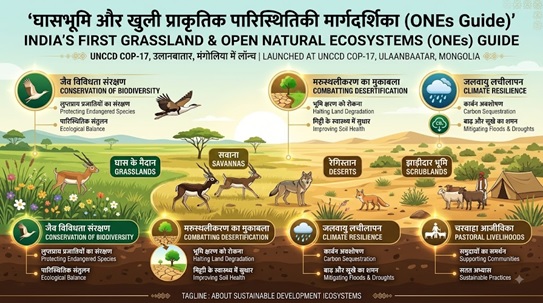
- At UNCCD COP-17, held in Ulaanbaatar, Mongolia, India released its first ‘Grasslands and Other Open Natural Ecosystems’ Guide.
Key Points:
- Main Objective: To highlight the rich diversity, ecological significance, and socio-economic importance of India’s grasslands, savannas, deserts, and other open natural ecosystems.
- Launch Date: 17 August 2026
- Launch Venue: Ulaanbaatar, the capital of Mongolia
- Collaborating Institutions: The guide has been prepared by the Ashoka Trust for Research in Ecology and the Environment (ATREE) under the guidance of the Ministry of Environment, Forest and Climate Change (MoEFCC), in collaboration with IUCN, CoE-SLM (Centre of Excellence for Sustainable Land Management), ICFRE, and ISRO’s Space Applications Centre (SAC).
- Ecological Classification: The guide classifies 24 ecosystem types across India.
- Geographical Coverage: It includes Himalayan and Terai grasslands, the Thar and Banni landscapes, Deccan savannas, rocky plateaus, ravines, shrublands, and coastal ecosystems.
Open Natural Ecosystems (ONE):
- These are natural landscapes where tree density is very low or negligible, and low-growing vegetation such as grasses and shrubs dominates.
- Biodiversity Hotspots: They are home to several threatened and unique species of India, such as the Great Indian Bustard, Lesser Florican, Indian Wolf, Blackbuck, Chinkara, and Caracal.
- Livelihoods and Pastoral Communities: The guide highlights the protection of traditional pastoral communities such as the Maldharis of Banni, Raika and Rabari communities of Rajasthan/Gujarat, Dhangars of Maharashtra, and Changpa of Ladakh, along with their livestock-based economy.
- Carbon Sequestration: Like forests, grasslands store significant amounts of carbon in their soils, which helps in climate change mitigation.
- Traditional Conservation Practices: Union Minister Bhupender Yadav specifically highlighted community and sacred lands such as ‘Orans’ and ‘Gochars’ in Ajmer, Rajasthan, which help maintain ecological balance.
UNCCD COP-17:
- Dates: 17–28 August 2026
- Host Country and City: Ulaanbaatar, Mongolia
- Theme: “Restoring Land, Restoring Hope”
- Presidency: Mongolia’s Foreign Minister Battsetseg Batmunkh has been elected President of the session.
- Member Countries: Representatives from 197 member countries of the United Nations Convention to Combat Desertification (UNCCD) are participating.
Significance of the ‘Triple COP’:
- 2026 is historically significant for the environment, as for the first time, all three major Rio Conventions’ COPs are being held in the same year, beginning with the desertification conference.
- UNCCD COP-17: Ulaanbaatar, Mongolia — Land and Desertification
- CBD COP-17: Yerevan, Armenia — Biodiversity
- UNFCCC COP-31: Antalya, Türkiye — Climate Change
Major Agendas and Discussion Areas:
- Moving Beyond Declarations to Action: The key message of the conference is that the world has made many commitments regarding land restoration, but now there is a need for funding and action on the ground.
- Global Drought Framework: At the previous conference, COP-16 in Riyadh, countries failed to reach agreement on a legally binding instrument to address drought. COP-17 is working to resolve this disagreement and develop a Drought Resilience Framework.
- Rangelands and Pastoralists: The United Nations has declared 2026 as the International Year of Rangelands and Pastoralists (IYRP 2026). Mongolia was a key proponent of this initiative; therefore, special emphasis is being placed on the rights of pastoral communities and grasslands.
- Drought Resilience Capacity Index (DRCI): The United Nations Environment Programme (UNEP) is launching a new technical tool at the conference to help countries measure their capacity to deal with drought.
Special Significance for India:
- First Grassland Guide: India released its first ‘Grasslands and Other Open Natural Ecosystems Guide’ on 17 August 2026 during the conference. It seeks to challenge the colonial mindset of treating open natural ecosystems as ‘wastelands’.
- India has committed to restoring its degraded land and achieving Land Degradation Neutrality (LDN) by 2030 under SDG Target 15.3.
- Representation of the Asia-Pacific Group: Speaking on behalf of the Asia-Pacific countries, India advocated for practical and balanced outcomes in global drought-management decisions.
Major Grasslands of the World:
- Savanna: Africa, especially East Africa such as Kenya and Tanzania. It is also known for extensive elephant grasslands.
- Llanos: Venezuela and Colombia — South America
- Campos: Plateau regions of Brazil — South America
- Caatinga: Northeastern dry region of Brazil
- Parkland: Africa
- Prairie: North America, especially the USA and Canada. They are known as the “Breadbasket of the World.”
- Pampas: Argentina, Uruguay, and Brazil — South America
- Veld: South Africa
- Downs: Australia
- Steppes: Eurasia, including Central Asia, Russia, and Eastern Europe
- Canterbury: New Zealand
- Puszta: Hungary — Europe
- Manchurian Grasslands: China and Mongolia
Major Grasslands and Open Habitats of India:
- Bugyals and Payars: Velvet-like alpine grasslands found in the high Himalayan regions of Uttarakhand.
- Margs: Mountain grasslands of Jammu and Kashmir, such as Sonamarg and Gulmarg.
- Banni Grasslands: Located in Kutch, Gujarat, and considered among Asia’s largest and finest tropical grasslands.
- Shola Grasslands: Found on the higher elevations of the Nilgiri, Anamalai, and Palani Hills of the Western Ghats, interspersed with dwarf forests.
- Khajjiar: Located in Himachal Pradesh; it is also known as the “Mini Switzerland of India.”
- Terai: Tall and moist grasslands found in the plains of northern India, particularly in Uttar Pradesh, Bihar, and West Bengal.
United Nations Convention to Combat Desertification (UNCCD):
- It is an international agreement aimed at protecting and restoring land and combating desertification, land degradation, and drought.
- Established: 1994
- The UNCCD was adopted at the Rio Earth Summit in 1992.
Potential Questions:
- Where was UNCCD COP-17 held in August 2026? Ulaanbaatar, Mongolia
- At which international forum did India launch its first 'Grassland Guide'? UNCCD COP-17
- How many ecosystem types have been classified in India's first grassland and open natural ecosystem guide? 24
- In which Indian state are the famous 'Banni Grasslands' located? Gujarat
- What is the primary objective of the UNCCD? To combat desertification and drought