GK Update
 
  • Mobile Menu
HOME BUY MAGAZINEnew course icon
LOG IN SIGN UP

Sign-Up IcanDon't Have an Account?


SIGN UP


Login Icon

Have an Account?


LOG IN
 

or
By clicking on Register, you are agreeing to our Terms & Conditions.


or


GK Update

Tue 18 Aug, 2026

National News

12th BRICS Environment Ministers' Meeting
  • The 12th BRICS Environment Ministers' Meeting was held in New Delhi under the chairmanship of the Union Minister for Environment, Forest and Climate Change, Bhupender Yadav.

Key Facts:

  • Venue: New Delhi (India)
  • Date: August 17-18, 2026
  • Chairperson: Union Minister for Environment, Forest and Climate Change, Bhupender Yadav
  • Theme of India's BRICS Presidency 2026: "Building for Resilience, Innovation, Cooperation and Sustainability"

Four priority areas identified by India:

  • Promoting sustainable lifestyles: Emphasis on eco-friendly consumption and community practices.
  • Afforestation, forest fire management, and disaster resilience: Prevention of forest fires and land restoration.
  • Circular economy: Waste management and Extended Producer Responsibility (EPR) framework.
  • Climate adaptation: Promoting traditional knowledge and community-led climate adaptation.

BRICS:

  • A group of the world's major emerging economies.
  • Full name: Brazil, Russia, India, China, and South Africa.
  • Concept: The term 'BRIC' was first coined by British economist Jim O'Neill in 2001.
  • First formal meeting: The first meeting of foreign ministers took place in New York in September 2006.
  • First summit: Held on June 16, 2009, in Yekaterinburg, Russia.
  • Inclusion of South Africa: South Africa became part of the group in 2010, after which the name changed from BRIC to BRICS.
  • New members (effective from January 1, 2024): Egypt, Ethiopia, Iran, and the United Arab Emirates (UAE).
  • Indonesia joined as a full member in the year 2025.
  • New Development Bank (NDB): Also known as the 'BRICS Bank'. It was established in July 2014 (during the Fortaleza Summit).
  • NDB Headquarters: Shanghai, China
  • Contingent Reserve Arrangement (CRA): A framework created to address global liquidity crises.
  • BRICS accounts for 45% of the world's population and 37.3% of the global GDP, surpassing the European Union (14.5%) and the G7 (29.3%).
  • With the inclusion of Iran, Saudi Arabia, and the United Arab Emirates (UAE), BRICS now accounts for approximately 44% of global crude oil production.

Summits and Presidency:

  • 16th Summit (2024): Kazan, Russia
  • 17th Summit (2025): Brazil
  • 18th Summit (2026): India (starting January 1, 2026)

Launch of 'AppCoMS 2.0'

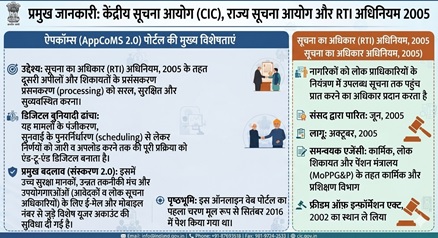
  • Raj Kumar Goyal, Chief Information Commissioner of the Central Information Commission (CIC), launched the advanced Appeal and Complaint Management System, 'AppCoMS 2.0'.
  • The first phase of this online web portal was originally introduced in September 2016.

Related Facts:

  • Name of the portal: AppCoMS 2.0 (Appeal and Complaint Management System)
  • Launched by: Raj Kumar Goyal (Chief Information Commissioner)
  • Date of launch: August 17, 2026
  • Associated Ministry/Department: Central Information Commission (CIC)
  • Objective: Online disposal of second appeals and complaints under the RTI Act.

Central Information Commission (CIC):

  • Formation: 2005 (under the Right to Information Act, 2005)
  • Appointment: By the President, on the recommendation of a committee
  • Committee composition: Chairperson: Prime Minister; Leader of the Opposition in the Lok Sabha; and a Union Cabinet Minister nominated by the Prime Minister
  • Current Chief Information Commissioner: Raj Kumar Goel (13th)
  • Tenure: Period determined by the Central Government or up to the age of 65 years (whichever is earlier)
  • Not eligible for reappointment

State Information Commission:

  • A statutory body
  • Formation: By the State Government
  • Appointment: By the Governor, on the recommendation of a committee
  • Committee composition: Chairperson: Chief Minister; Leader of the Opposition in the Legislative Assembly; and a State Cabinet Minister nominated by the Chief Minister
  • Salary, allowances, and other service conditions: Determined by the Central Government

Right to Information (RTI) Act, 2005:

  • Grants citizens the right to access information held under the control of public authorities
  • Passed by Parliament: June 2005
  • Enforced: October 2005
  • Nodal agency: Department of Personnel and Training under the Ministry of Personnel, Public Grievances and Pensions (MoPPG&P)
  • Replaced the Freedom of Information Act, 2002

Books and Authors

'Popular leader Venkaiah Naidu: From Udayagiri to Vice President' released
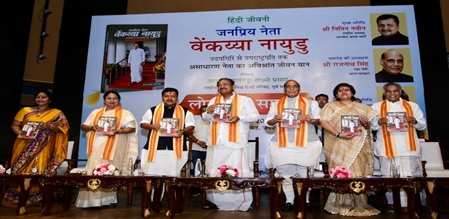
  • Defense Minister Rajnath Singh released the Hindi book 'People's leader Venkaiah Naidu: From Udayagiri to Vice President' based on the biography of former Vice President M. Venkaiah Naidu.
  • The author of this book is former Rajya Sabha MP Y. This is Lakshmi Prasad.
  • This book outlines the life journey of former Vice President of India M. Venkaiah Naidu from a simple farmer family to the country's second highest constitutional post (Vice President), his political struggles and dedication to democratic values.

Related facts:

  • Name of the book: 'Popular leader Venkaiah Naidu: From Udayagiri to Vice President'
  • Author: Acharya Y. Lakshmi Prasad
  • Released by: Rajnath Singh (Union Defense Minister)
  • Which Vice President of the country?: M. Venkaiah Naidu was the 13th Vice President of India (from 2017 to 2022).
  • Highest civilian honour: He was awarded 'Padma Vibhushan' (India's second highest civilian honour) in the year 2024.
  • Early political journey: He was first elected MLA (MLA) from Udayagiri assembly constituency of Andhra Pradesh in 1978 and 1983.
  • Party President: He was the National President of BJP from 2002 to 2004.
  • Article 63: There shall be a Vice President of India
  • Article 64: The Vice President is the ex-officio Chairman of the Rajya Sabha
  • Minimum Age Limit: The minimum age for the Vice President of India is 35 years

Awards and Honors

General Dheeraj Seth Honored as Honorary General of the Nepalese Army
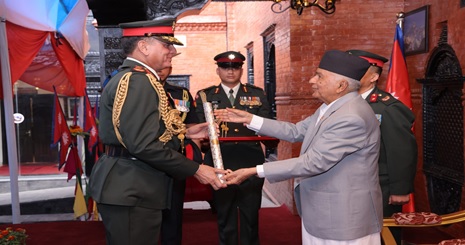
  • Indian Army Chief General Dheeraj Seth was conferred the title of Honorary General of the Nepalese Army by the President of Nepal, Ramchandra Paudel, at a ceremony held at 'Sheetal Niwas' in Kathmandu.
  • General Dheeraj Seth had arrived in Nepal on Sunday at the invitation of the Nepalese Army Chief, General Ashok Raj Sigdel.

Related Facts:

  • India-Nepal Military Relations: Honorary General Title:
  • Tradition Began: 1950
  • First Indian Recipient: Field Marshal K.M. Cariappa
  • Nature: The President of India confers the title upon the Nepalese Army Chief, and the President of Nepal confers it upon the Indian Army Chief.

Strategic Significance:

  • Strengthens 'people-to-people' ties and defense diplomacy
  • Historical association with the Indian Army's Gorkha Brigade
  • Serves as a channel for 'Track-1.5' (trusted dialogue) during diplomatic tensions
  • India-Nepal Border: Both countries share an open border approximately 1,751 kilometers long.
  • Indian States Bordering Nepal: Five Indian states share a border with Nepal — Uttarakhand, Uttar Pradesh, Bihar, West Bengal, and Sikkim.
  • Joint Military Exercise: The annual joint military exercise between India and Nepal is named 'Surya Kiran'.
  • Indian Army Chief (COAS): General Dheeraj Seth is India's 31st Army Chief; he assumed office on June 30, 2026. He belongs to the Armoured Corps.
  • Venue: Sheetal Niwas, the official residence of the President of Nepal (Kathmandu).

Nepal:

  • Official Name: Federal Democratic Republic of Nepal
  • Capital: Kathmandu (also the largest city in Nepal)
  • Currency: Nepalese Rupee (NPR)
  • Official Language: Nepali
  • President: Ramchandra Poudel
  • Prime Minister: Balen Shah
  • Parliament Name: Federal Parliament; it has two houses: the House of Representatives (Lower House) and the National Assembly (Upper House)
  • Area: Approximately 147,181 square kilometers
  • Geographical Classification: Nepal is primarily divided into three regions — Himal (mountainous region), Pahad (hilly region), and Terai (plain region)
  • World's Highest Peak: Mount Everest (Height: 8848.86 meters) is located in Nepal; it is known locally as 'Sagarmatha'
  • Major Rivers: Koshi (also known as the 'Sorrow of Bihar'), Gandak (known as Narayani in Nepal), Karnali (Nepal's longest river), and Mahakali (Sharda River)
  • Border Security Force: The India-Nepal border is secured by the Sashastra Seema Bal (SSB).
  • World Heritage Sites (UNESCO Sites): Kathmandu Valley, Lumbini (birthplace of Lord Buddha), Chitwan National Park, and Sagarmatha National Park.
  • Famous Temple: Pashupatinath Temple (Kathmandu), situated on the banks of the Bagmati River; it is a sacred site for Hindus.
  • SAARC Headquarters: The Secretariat of the South Asian Association for Regional Cooperation (SAARC) is located in Kathmandu.
  • National Animal: Cow (cows are considered highly sacred in Nepal)
  • National Bird: Danphe (Himalayan Monal)
  • National Sport: Volleyball (declared in 2017)
  • National Flower: Laligurans (Rhododendron)
  • National Flag: Nepal's flag is the only national flag in the world that is not rectangular; it is composed of two triangular shapes.

Over 200 Indian Peacekeepers Honored with UN Medals
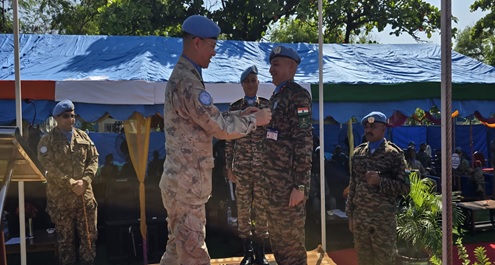
  • 210 Indian peacekeepers deployed under the United Nations Mission in South Sudan (UNMISS) were awarded the United Nations Medal.
  • This contingent included 6 female peacekeepers and 7 staff officers.

Key Facts:

  • The mission described this as a proud moment for India's 'Blue Helmets'.
  • India is the second-largest contributor of uniformed personnel to UN peacekeeping operations.
  • Currently, India has over 4,200 military and police personnel—including 155 women—deployed in ongoing UN peacekeeping operations across various countries.
  • These missions cover areas including Abyei, the Central African Republic, Cyprus, the Democratic Republic of the Congo, Lebanon, the Middle East, Somalia, South Sudan, and Western Sahara.
  • As of April this year, India was the largest military contributor to the UN mission in South Sudan.
  • 1,775 Indian military personnel were deployed with the United Nations Mission in South Sudan.
  • Venue of the award ceremony: Juba (capital of South Sudan).
  • Nickname for soldiers: UN peacekeepers are known as 'Blue Helmets'.
  • History of women's contingents: In 2007, India became the first country to deploy an all-female police contingent under a UN peacekeeping mission (in Liberia).

United Nations Peacekeeping Force:

  • Year of establishment: 1948 (the first mission was sent to the Middle East).
  • Nobel Peace Prize: The UN Peacekeeping Force was awarded the prestigious Nobel Peace Prize in 1988.
  • Control: It operates under the mandate of the United Nations Security Council (UNSC).
  • 3 Core Principles: Consent of the parties, impartiality, and use of force only in self-defense.
  • International Day of UN Peacekeepers: Observed annually on May 29.

Reports and Indices

Country's Unemployment Rate in July 2026
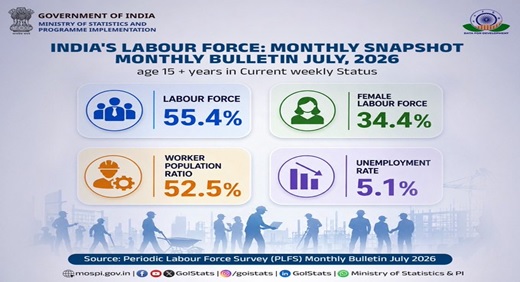
  • According to the monthly Periodic Labour Force Survey (PLFS) report released by the National Statistical Office (NSO), the overall unemployment rate for the population aged 15 years and above in the country declined to 5.1% in July 2026, down from 5.5% in June.

Related Facts:

  • The rural unemployment rate fell to 4.5% during the month, compared to 5% in June.
  • The urban unemployment rate saw a marginal increase to 6.7% in July, up from 6.6% in June.
  • The overall unemployment rate among women dropped to 5.4%, while among men, it fell to 5%.
  • Overall unemployment figure for July: The unemployment rate for the population aged 15 years and above declined to 5.1% in July (compared to 5.5% in June).
  • Issuing Agency: This data was released by the National Statistical Office (NSO).
  • Nodal Ministry: The NSO operates under the Ministry of Statistics and Programme Implementation (MoSPI).
  • Urban vs. Rural Unemployment: In July, rural unemployment stood at 4.5% (decreased), while urban unemployment was 6.7% (marginally increased).
  • Labour Force Participation Rate (LFPR): The percentage of the country's population that is either working or seeking work (55.4% in July).
  • Worker Population Ratio (WPR): The percentage of employed (working) individuals within the total population (52.5% in July).
  • Unemployment Rate (UR): The percentage of people within the labour force who did not find work. CWS (Current Weekly Status): Under this, if a person has worked for even one hour on any single day during the reference week, they are considered employed.
  • Formation of NSO: In 2019, the government constituted the National Statistical Office (NSO) by merging the National Sample Survey Office (NSSO) and the Central Statistics Office (CSO).
  • Headquarters: New Delhi.
  • Periodic Labour Force Survey (PLFS): It was launched in April 2017 to ensure the availability of regular employment data.

International News

Zambia Presidential Election

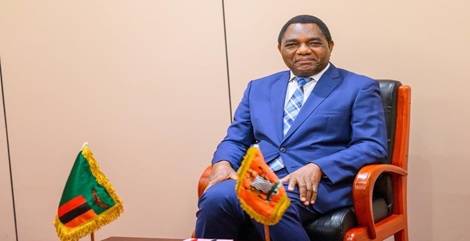
  • Zambian President Hakainde Hichilema has been re-elected for a second five-year term.
  • According to the Election Commission, Hichilema received 2,965,326 votes, while his closest rival, opposition leader Brian Mundubile, secured 1,856,217 votes.

Key Facts:

  • New President: Hakainde Hichilema has been re-elected as the President of Zambia for a second five-year term.
  • Popular Nickname: He is also known among the public as 'Bally'.
  • Political Party: He belongs to the 'United Party for National Development' (UPND).
  • Main Rival: He defeated opposition alliance leader Brian Mundubile.
  • Vote Percentage: Hichilema secured approximately 60.49% of the votes.

Zambia:

  • Capital: Lusaka
  • Official Currency: Zambian Kwacha
  • Continent: It is a country in Africa (Southern Africa).
  • Geographical Feature: Zambia is a landlocked country.

Environment News

First Guide on 'Grasslands and Other Open Natural Ecosystems'
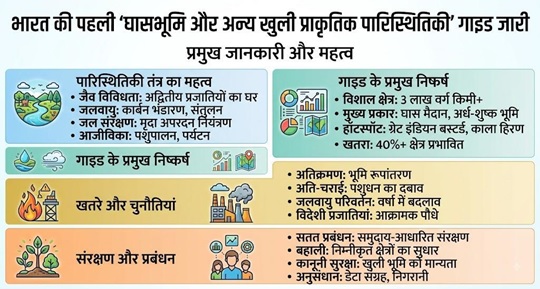
  • India has released its first guide on 'Grasslands and Other Open Natural Ecosystems'.

Key Facts:

  • Name of the Guide: 'Guide to Grasslands and Other Open Natural Ecosystems (ONEs)'
  • Launch Date: The guide was released on August 17, 2026.
  • Launch Venue: It was launched in Ulaanbaatar, the capital of Mongolia.
  • International Conference: It was released during the UNCCD COP17 (17th Conference of the Parties) conference.
  • Union Minister: Union Minister for Environment, Forest and Climate Change, Bhupender Yadav, delivered a virtual address on the occasion.
  • Collaborating Institutions: It was prepared by the Bengaluru-based ATREE (Ashoka Trust for Research in Ecology and the Environment) in collaboration with MoEFCC, ISRO (SAC), and ICFRE.
  • Ecosystem Types: The guide classifies 24 types of open natural habitats found in India.
  • Key Areas (ONEs): These primarily include Himalayan and Terai grasslands, the Thar and Banni landscapes (Gujarat), Deccan savannas, rocky plateaus, and ravines.
  • Banni Grasslands: These are among the largest grasslands in Asia, located in the Kutch region of Gujarat.

Major Grasslands of the World:

  • Savanna: African continent (especially East Africa, such as Kenya and Tanzania). Also known as the 'Elephant Grass' region.
  • Llanos: Venezuela and Colombia (South America).
  • Campos: Plateau regions of Brazil (South America).
  • Caatinga: Northeastern arid region of Brazil.
  • Parkland: Africa.
  • Prairies: North America (USA and Canada). Known as the 'Breadbasket of the World'. Pampas: Argentina, Uruguay, and Brazil (South America)
  • Veld: South Africa
  • Downs: Australia
  • Steppes: Eurasia (Central Asia, Russia, and Eastern Europe)
  • Canterbury: New Zealand
  • Puszta: Hungary (Europe)
  • Manchurian: China and Mongolia

Major grasslands and open habitats of India:

  • Bugyal and Payar: Velvet-like grasslands found in the high Himalayan regions of Uttarakhand.
  • Marg: Mountainous grasslands of Jammu & Kashmir (e.g., Sonmarg, Gulmarg).
  • Banni Grasslands: One of Asia's largest and finest tropical grasslands, located in the Kutch region of Gujarat.
  • Shola: Grasslands interspersed with stunted forests, found on the high peaks of the Nilgiri, Annamalai, and Palani hills (Western Ghats, South India).
  • Khajjiar: Himachal Pradesh (also known as the 'Mini Switzerland' of India).
  • Terai: Tall and moist grasslands found in the plains of North India (UP, Bihar, West Bengal).

Hurricane Lala

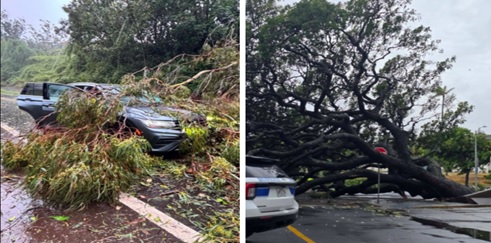
  • 'Hurricane Lala' disrupted normal life on the Big Island of Hawaii, USA.

Related Facts:

  • Name: Cyclone Lala
  • Time: August 2026
  • Affected Areas: Hawaii's 'Big Island' and Maui, USA
  • Cyclone Category: It was a Category 1 cyclone with wind speeds of approximately 120 to 140 km/h.
  • Historical Record: It is the first cyclone in 155 years (since 1871) to pass closest to Hawaii's Big Island (approximately 30 miles away).
  • Geographical Cause: The storm gained energy from rising sea temperatures caused by a 'Super El Niño' and marine heatwaves active in the central Pacific Ocean.

Local Names for Cyclones:

  • Hurricane: Atlantic Ocean and Eastern/Central Pacific Ocean (e.g., storms hitting Hawaii and the USA)
  • Typhoon: Northwest Pacific Ocean (China, Japan, Philippines)
  • Cyclone: ​​Indian Ocean (India, Bangladesh, Oman)
  • Willy-Willy: Australia (asked in past exams, though it is now referred to as a 'cyclone' there as well)
  • Cyclone Measurement Scale: Hurricane intensity is measured using the 'Saffir-Simpson Scale' (which ranges from Category 1 to 5).
  • In 2026, several destructive and powerful tropical cyclones (cyclones, hurricanes, and typhoons) occurred globally due to 'Super El Niño' and rising sea temperatures.
  • Hurricane Lala: In August 2026, this cyclone caused massive devastation on the Big Island and Maui in the US state of Hawaii. For the first time in 155 years, a storm passed so close to Hawaii, resulting in record rainfall exceeding 35 inches, flash floods, and widespread power outages.
  • Typhoon Noul: Striking in late July 2026, this became the most powerful typhoon to hit China that year. It primarily affected China's Guangdong province, necessitating the relocation of over 700,000 people to safety.
  • Typhoon Sinlaku: Originating in the western Pacific Ocean in April 2026, this was the year's most intense and powerful typhoon, recording a minimum atmospheric pressure of 905 hPa at sea.
  • Hurricane Genevieve: Emerging in the eastern Pacific Ocean in late July 2026, this storm became the first Category 5 "extremely severe" hurricane of the year.
  • Tropical Storm Arthur: Forming in June 2026, this was the season's first Atlantic storm, primarily affecting the Gulf of Mexico.
  • Tropical Storm Bertha: Striking in July 2026, this storm impacted the southern Gulf coast of the United States and brought heavy rainfall to coastal areas.
  • Cyclone Horacio: Occurring in the southwest Indian Ocean in February 2026, this was an extremely powerful Category 5 cyclone and the most intense early-year storm in the region.
  • Cyclone Gezani: This cyclone wreaked havoc in Madagascar. It proved to be the deadliest storm of 2026 so far, claiming the lives of more than 60 people.

Sports News

Asian Junior Blitz Chess Championship 2026
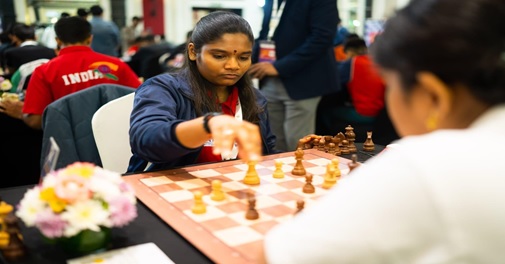
  • At the Asian Junior Blitz Chess Championship 2026, India's Vignesh Vemula won the gold medal in the Open category, while Saranya Devi Narahari won gold in the Girls' category.
  • The tournament was held on August 17, 2026, at the ITC Maratha Sheraton in Mumbai, under the aegis of the Maharashtra Chess Association.

Key Details:

  • Winner (Open Category): Vignesh Vemula, 23rd-seeded Indian player (Gold Medal)
  • Winner (Girls' Category): Saranya Devi Narahari, 9th-seeded Indian player (Gold Medal)
  • Venue: Mumbai, India (ITC Maratha Sheraton)
  • Date: August 17, 2026
  • Organizer: Under the aegis of the Maharashtra Chess Association
  • Inaugurated by: Former BMC Commissioner Jayraj Pathak
  • Time Control: Blitz format – 3 minutes plus a 2-second increment
  • Clean sweep in the Open category: India won all three top medals
  • Silver: Viresh Sharanarthi
  • Bronze: Nandish V.S.

Girls' Category:

  • Silver: Lala Shohradova (Turkmenistan — top-seeded player)
  • Bronze: Sannidhi Bhat / Prishita Gupta (India)


Latest Courses