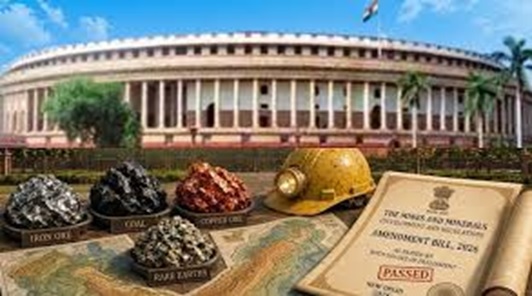
The Mines and Minerals (Development and Regulation) Amendment Bill, 2026
 
  • Mobile Menu
HOME BUY MAGAZINEnew course icon
LOG IN SIGN UP

Sign-Up IcanDon't Have an Account?


SIGN UP


Login Icon

Have an Account?


LOG IN
 

or
By clicking on Register, you are agreeing to our Terms & Conditions.


or


The Mines and Minerals (Development and Regulation) Amendment Bill, 2026

Fri 14 Aug, 2026

The Mines and Minerals (Development and Regulation) Amendment Bill, 2026 marks a significant structural change in India’s mining sector. The Bill was passed by Parliament during the Monsoon Session of 2026, with the Lok Sabha clearing it on 12 August 2026 and the Rajya Sabha approving it on 13 August 2026. The Ministry of Mines is the nodal ministry responsible for this legislative reform, which amends the foundational Mines and Minerals (Development and Regulation) Act, 1957 (MMDR Act).

The principal objective of the amendment is to bring greater certainty, stability and predictability to the mining sector by establishing a more uniform fiscal and regulatory framework across states. The reform seeks to address concerns arising from differing state-level taxation and levies on mineral resources and mineral-bearing land.

Background and Constitutional Context

  • The amendment is presented as a legislative response to the 2024 judgment of the nine-judge Constitution Bench of the Supreme Court in Mineral Area Development Authority v. SAIL. According to the provided material, the judgment gave states autonomous powers to impose taxes on mineral rights and mineral-bearing lands.
  • The resulting possibility of varying fiscal regimes across states was viewed as creating uncertainty for the mining industry.
  • The amendment therefore seeks to establish a more predictable framework for mineral-related taxation and regulation.

Constitutional provisions related to Act:

  • Union List, Entry 54: Regulation of mines and mineral development, giving the Central Government authority over major minerals.
  • State List, Entry 23: Regulation of mines and mineral development, subject to the provisions of the Union List.
  • State List, Entry 49: Taxes on lands and buildings.
  • State List, Entry 50: Taxes on mineral rights, subject to limitations imposed by Parliamentary legislation.

These provisions are particularly relevant to questions concerning Centre-State relations, federalism and natural-resource governance.

Major Provisions

  • One of the major reforms is the restriction on state taxation. State governments will be barred from imposing new taxes, cesses or additional levies on mineral rights or mineral-bearing land without explicit Central approval. The framework also provides for the invalidation of certain unrecovered past state levies that fall outside the prescribed uniform framework.
  • Another important change concerns captive mines. The existing 50% ceiling on the sale of minerals from captive mines is removed. Captive mine operators will consequently be permitted to sell 100% of their surplus mineral production after meeting their own industrial requirements. This measure is expected to provide greater flexibility to captive mining operations.
  • The amendment also facilitates the integration of critical and strategic minerals into existing mining leases. Minerals specifically highlighted include lithium, nickel, graphite and cobalt, all of which are important for modern industries, clean-energy technologies and strategic manufacturing.
  • The Bill further provides for the establishment of a dedicated mechanism to register and regulate electronic Mineral Exchanges. Such exchanges are intended to facilitate transparent online trading of metals and minerals and improve the efficiency of mineral markets.

Major and Minor Minerals

  • The amendment maintains a distinction between major and minor minerals. According to the supplied material, the Central Government regulates major minerals such as coal, iron ore, limestone, copper and manganese, while states retain regulatory and execution-related powers over 49 minor minerals, including sand, clay and gravel.
  • This division of responsibilities is important for understanding India's federal framework for natural-resource management.

Strategic Significance

  • The amendment is also aligned with the objectives of the National Critical Mineral Mission (NCMM).
  • Critical minerals such as lithium, cobalt, nickel and graphite are increasingly important for batteries, renewable-energy systems, electronics and advanced technologies. Greater domestic exploration and production can therefore help India reduce dependence on external sources.

National Critical Mineral Mission (NCMM)


  • Launch / Approval: Approved by the Union Cabinet in early 2025 (building on the 30 critical minerals identified for India).
  • Nodal Ministry: Ministry of Mines.
  • Target: Undertake 1,200 exploration projects via the Geological Survey of India (GSI) through 2030–31.

Critical Minerals Focus

  • Total Identified: 30 critical minerals for India.
  • Top Examples: Lithium, Cobalt, Nickel, Graphite, Rare Earth Elements (REEs), Titanium, and Tungsten.
  • Notable Exclusions: Precious metals like Gold are not classified under the NCMM as they lack advanced/green-tech application.

Other Facts

  • Union Minister of Coal and Mines: Shri G. Kishan Reddy.
  • Union Minister of State for Coal and Mines: Shri Satish Chandra Dubey.

Important Mines and Minerals sites in India

Mineral Category Top Producing States Important Mines / Sites
Iron Ore Metallic (Ferrous) Odisha, Chhattisgarh, Karnataka, Jharkhand Bailadila (Chhattisgarh), Mayurbhanj/Keonjhar (Odisha), Noamundi (Jharkhand), Sandur-Hospet (Karnataka)
Coal Energy/Fuel Jharkhand, Chhattisgarh, Odisha, Madhya Pradesh Jharia & Bokaro (Jharkhand), Korba (Chhattisgarh), Talcher (Odisha), Singrauli (Madhya Pradesh/Uttar Pradesh)
Bauxite Metallic (Aluminium) Odisha, Gujarat, Chhattisgarh, Jharkhand Panchpatmali/Koraput (Odisha), Lohardaga (Jharkhand), Amarkantak (Madhya Pradesh/Chhattisgarh)
Manganese Metallic (Alloy) Madhya Pradesh, Maharashtra, Odisha Dongri Buzurg (Maharashtra) [5.6], Balaghat & Chhindwara (Madhya Pradesh)
Copper Metallic (Non-Ferrous) Madhya Pradesh, Rajasthan, Jharkhand Malanjkhand (Madhya Pradesh), Khetri (Rajasthan), Singhbhum (Jharkhand)
Lead & Zinc Metallic (Non-Ferrous) Rajasthan Rampura Agucha & Zawar Mines (Rajasthan)
Gold Precious Metal Karnataka, Jharkhand Kolar Gold Fields & Hutti (Karnataka), Hira Buddini (Karnataka)
Diamond Precious Gemstone Madhya Pradesh Panna Diamond Mines (Madhya Pradesh)
Uranium Strategic/Energy Jharkhand, Andhra Pradesh Jaduguda & Turamdih (Jharkhand), Tummalapalle (Andhra Pradesh)
Limestone Non-Metallic Rajasthan, Madhya Pradesh, Chhattisgarh Baloda Bazar (Chhattisgarh), Chittorgarh & Jaisalmer (Rajasthan), Katni (Madhya Pradesh)

Latest Courses